


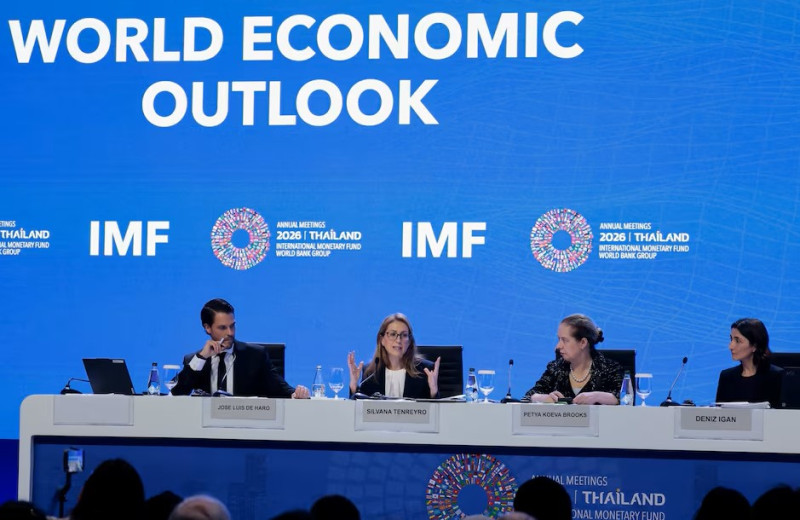
A SHARP correction in artificial intelligence investments, surging government bond yields or a major cyberattack could trigger global financial turmoil, the International Monetary Fund (IMF) warned, cautioning that strong market performance should not be mistaken for safety.
In its latest Global Financial Stability Report released on Tuesday, the IMF said AI investment had helped offset economic pressures from the Middle East conflict and broader policy uncertainty, but warned that expectations of the technology’s returns could prove overly optimistic.
“An AI market correction will affect the real economy,” Athanasios Vamvakidis, deputy director of the IMF’s Monetary and Capital Markets Department, said at a press briefing in Bangkok.
He said global risk appetite remained strong, supported by robust corporate earnings and optimism over AI, but cautioned that resilience did not necessarily mean markets were safe.
An AI-driven selloff could erode wealth, reduce investment and spill over into other markets, he said.
The IMF identified an AI investment correction, a spike in sovereign bond yields and a major cyberattack as plausible near-term triggers of tighter financial conditions and wider market disruption.
While each risk might be manageable on its own, Vamvakidis warned that they could expose underlying vulnerabilities with broader systemic consequences.
The Fund said growing leverage in the AI sector could amplify a slowdown in investment by forcing investors to sell assets, increasing volatility across financial markets.
Hyperscalers now account for 10 per cent of global investment-grade bond issuance, compared with less than one per cent in 2024, highlighting the sector’s growing footprint in debt markets.
“The consequences of an AI correction could be global,” the IMF warned, urging policymakers to curb excessive leverage, including through derivatives and margin loans.
Reuters, on Tuesday, cited that the report also flagged mounting pressure in bond markets since its April assessment, as higher energy prices pushed up government borrowing costs while historically high sovereign debt and unresolved fiscal deficits in major economies added to the strain.
Vamvakidis said markets faced a growing supply of government and corporate bonds at a time when central banks were reducing their balance sheets, leaving greater reliance on investors sensitive to price changes.
The IMF noted that bond markets had so far absorbed the pressure without major disruption, including as hedge funds unwound some repurchase-agreement borrowing without destabilising those markets. It urged governments to put public debt on a sustainable path.
Cybersecurity was another major concern, particularly in emerging markets where limited resources and dependence on a small number of critical technology providers were complicating efforts to defend financial systems.
In more than 70 per cent of cases so far in 2026, software providers had almost no time to patch vulnerabilities before they were exploited, a 20-percentage-point increase from a year earlier, the IMF said.
Although AI could help strengthen cyber defences, the technology was also making attacks more sophisticated.
The Fund warned that an attack on a critical service or financial institution could undermine confidence and rapidly spread disruption across markets. It called for stronger cybersecurity capabilities and tighter oversight of third-party technology vendors.
Despite the risks, IMF stress tests found that banks’ capital buffers remained robust under a hypothetical downturn triggered by slower AI investment and fragile bond markets.
However, the tests also revealed pockets of weakness: banks accounting for 22 per cent of global banking assets had weak capital levels under the latest scenario, up from 18 per cent in the 2025 test. - October 13, 2026